Opening the taps: mobilising clean energy capital for Australia’s energy future
Sign up for updates
Sign up to receive occasional updates on major climate and energy finance news and developments, and notification of new reports, presentations and resources.
"*" indicates required fields
Read our privacy statement here.
Opening the taps: mobilising clean energy capital for Australia’s energy future
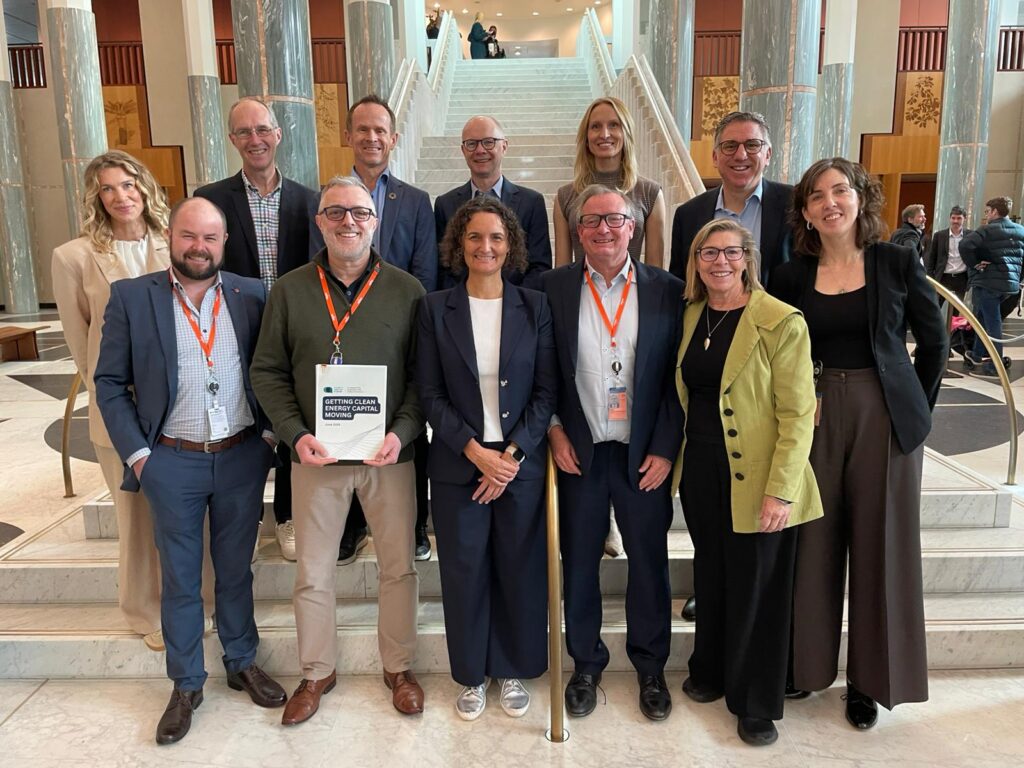
Members of the Climate Capital Forum were in Parliament House this week meeting with parliamentarians across party lines, ministerial advisors and Treasury officials to make a straightforward case: Australia has the capital, technology, and ambition to lead the clean energy transition – but the settings that control how that capital flows need urgent attention.
Our Climate Capital Forum delegation focused on three interconnected funding streams, each of which is facing constraints in ways that are slowing the transition and weakening Australia’s competitive position.
Public funding deployment is fundamental to Australia’s clean energy transition success, with tens of billions committed through ARENA, the CEFC, and NRF. But commitment is not delivery. Our discussions centred on how co-investment settings between government and private capital can be redesigned to accelerate the pace of deployment – getting money off balance sheets and into projects on the ground. This is crucial to meeting our climate targets, establishing clean industry, and building public confidence through jobs, economic activity and the real proof points that clean energy is delivering a secure energy future for Australia.
Superannuation is the quiet giant in this conversation. Australia’s super funds manage $4.4 trillions in retirement savings, and a meaningful share of that capital is already in long-term infrastructure investment. But the current performance test framework creates structural disincentives that push funds away from Australian innovation and the patient, illiquid capital that clean energy projects need. We met with Treasury officials and parliamentarians to make the case for urgent reform that will help unlock our own retirement investment in super so that at least some of it can be invested in decarbonising innovation right here in Australia. (If you’re keen to dive deeper, see our full submission to Treasury’s consultation on this issue here.)
Foreign investment – proposed changes to the capital gains tax treatment of foreign investors in Australian infrastructure risks turning that tap off by applying tax increases retroactively and not addressing the need for up to 15 years favourable tax amounts for projects to be delivered. We risk sending signal that investing in Australia is risky and changeable for international investors.
We need to ensure capital drives the energy transition at the scale and speed Australia and the planet needs, for a secure and stable future.
Our delegation of clean tech, commercial renewables, policy, sustainable finance and investment experts brought their real-world experience to Canberra to make sure decision-makers have the information they need to get the settings right in this crucial energy transition.
READ THE POLICY BRIEFS: